

CLOSE-UP ON SPECIAL
Updated: Sep 28
Parenthood is one of the most documented experiences in human history — and one of the least honestly discussed. Over the last decade, the mental health of U.S. parents has measurably worsened. Between 2016 and 2023, cis-mothers reported a nearly 65% increase in "fair to poor" mental health. Yet, maternal mental health disorders affect roughly 600,000 — or 20% — of U.S. mothers every year. Further, it is estimated that upwards of 50% of those mothers are never diagnosed by a healthcare professional, and that 75% never receive the treatment they need. With our sole evolution depending on our ability to raise children, why aren’t we doing a better job at talking about it?
These statistics are the backdrop of ordinary life for millions of birthing people navigating pregnancy, postpartum, and early parenthood — often without adequate support, language for what they are experiencing, or access to care.
Adoption adds another layer entirely. In the United States, over 368,000 children are in foster care on any given day. Over 108,000 of them are eligible for adoption and will wait, on average, nearly three years for a permanent family.
No two motherhood stories are the same. Not the ones that begin in delivery rooms, adoption agencies, or courtrooms.

CLOSE-UP WITH GINA.
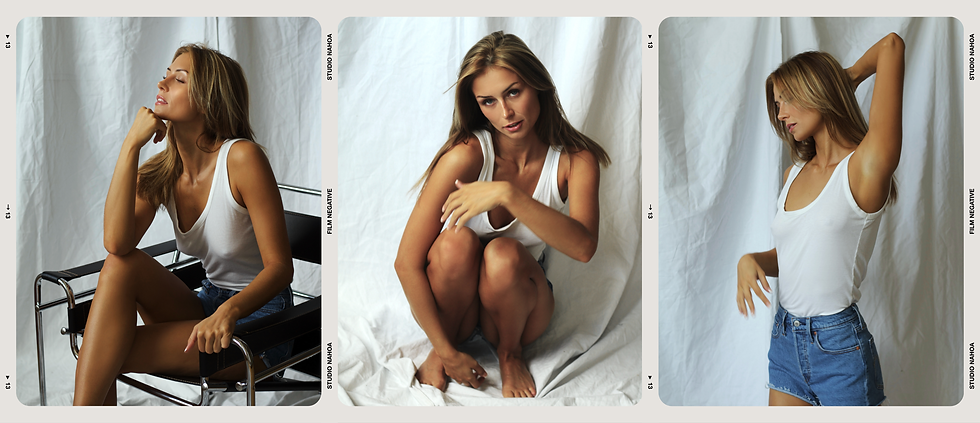
In this series, we'll be going over national conversations and getting a close-up view of how the people in my orbit navigate life. As a society, we've reached this point in our skills and evolution to bond and relate to one another. I hope this series serves as a raw conversation to destigmatize our very human lives and the things we go through. In today's series, we'll be connecting with Gina: stunning, composed, sharp. Then, there's the version that people closest to her know: the daughter who shows up, the friend who remembers, and the mother who would move mountains before breakfast — as she often does.
Q: Tell me about your family — where you come from, who raised you, what that looked like.
A: The best way I can describe my family is using the analogy of a quilt. Pieces of different fabric, from different places, coming together to create something beautiful. My parents couldn’t conceive, so they adopted all 4 of us kids. My oldest brother is from Nebraska, my older sister is Romanian, I’m Bosnian, and finally, my younger brother is South Korean. My siblings are my best friends; growing up, we fought like cats and dogs — I’m sure we stressed my mother out, but I would do it all over again in a heartbeat.
Q: Walk me through your very first beauty memory — how has your self-image evolved since?
A: I was obsessed with those toy makeup palettes that looked like flip phones. I always had some form of lip gloss on me; my mom was a good sport and funded my addiction while I was little. I even remember one time I sliced my finger open because I shut it in an old lip gloss. Beauty hurts! I definitely find beauty within myself a lot easier now than when I was in high school. I was way too hard on myself in my teens and never gave myself credit for all of the things I was doing — I was only ever looking at what I DIDN'T have or WASN'T doing. It's corny, but it's true: Beauty really does come from within.
MEETING GINA
Gina and I met in small-town USA at an even smaller boutique. Fast forward 7-8 years, and we’re back for another photography sesh.
We met in 2017 or 2018 as I was pulled together pieces for the first benefit fashion show in town — an event that brought all the local shops together, centered around Aveda's ethos of earth and sustainability. For two Virgos, the theme truly chose us.
That afternoon, we quickly synced and settled on the pieces, hung them up for the show, and counted down the days like it was Christmas. Gina's look was pretty simple, and with the palm-printed scarf we wrapped around her head, shooting it next to some olives made it feel like some European vacation.

THE SHOOT
Q: Take me back to the day of our first shoot together — what was going through your mind?
A: I vaguely remember practicing faces in my Camry's rear-view mirror before the shoot. I wanted to make sure I was confident in my angles and what would look good on camera ahead of time. Aside from that, upon arriving, any anxiety ended up dissipating. Chemistry with a photographer is so important!
STYLE & IDENTITY
Q: How would you describe your personal style — and is there a version of yourself you've now retired?
A: Unique, Realistic, Chic. I've certainly softened up a lot in the last decade. I was very angry at the world — sigh, typical angsty teen — and I think it showed in everything about me, aesthetic included. I was very "on trend" and wanted to be like everybody else.
Now I want my style to remind people of nobody at all.
I want my vibe to be entirely my own.
Q: Who are the women whose style has shaped yours?
A: Fictional, but hear me out: Aelin Galathynius — because even the most badass, spitfire assassins love jewels and dresses.

MOTHERHOOD & PERSPECTIVE
While we bonded fast, we've lived in different towns for most of our friendship. Before this shoot, Gina and I hadn't seen each other in a few years, and in that time, she became a mom to Azra.
Pregnancy and motherhood can be consuming and, for many, the most transformative experience of one's life. While there are plenty of books and guides on the journey, no pregnancy is the same — and neither is the motherhood that follows.
Fast forward a few years, and Gina mentioned she needed headshots. It felt less like a job and more like an excuse we'd both been waiting for. We planned for a sitter, the shoot, FaceTimed each other ten million times, dug through her closet, and eventually hauled what felt like 500 pounds of makeup, clothing, and equipment to the studio.
Q: You come from a family with a lot of different personalities and perspectives. Now you're building your own. How has where you come from shaped the kind of mother you are?
A: I really appreciate all of the differing perspectives and experiences I’ve had that led up to me becoming a mother. My younger brother was born with 7 fingers, and we unfortunately bear no resemblance to each other, so there were always questions from others.
For a long time, it was really frustrating, and I would lash out, but over time, I learned to let it roll off my back, because that’s what my little brother always did. Now that’s a tool I use daily, raising a daughter with special needs.

ON BECOMING A MOTHER
Q: What do you wish someone had told you before you had Azzy — about your body, your mind, all of it?
A: I definitely wish I had known more about the labor and delivery process itself. Azra came 2 months early, so I hadn’t even gotten around to learning about it yet—I went in totally ignorant.
Without getting into too gritty of the details, there’s just a lot of reactions and things our bodies do/feel during the process that caught me completely off guard. Be informed!!!
Q: Postpartum is something nobody really prepares you for. What has that chapter looked like for you?
A: Postpartum was the hardest time of my life. Between the depression, Azra being ill, and the sleep deprivation, I didn’t think I’d survive.
I definitely wouldn’t have without my support system. Luckily, I have amazing friends and family that I was able to lean on throughout the process. I also consulted with my doctor and used medicinal support as well.
Q: How has becoming a mother shifted the way you see yourself — and what has it taught you about patience?
A: I have a lot more respect for myself and patience. It became infinitely easier to set boundaries within my personal relationships when my time became so limited. I've learned I'm much more optimistic than I ever gave myself credit for as well.
I think patience has nothing to do with waiting and everything to do with optimism. Nobody is going to keep their cool in a time of uncertainty or fear; it's human nature. I think the best we can do is prepare for the worst and hope for the best. If we lose hope, then patience has no point.
It's easy to lose yourself in times of growth, but I think staying positive will always help us find our way back.
Q: What does it mean to raise a child who sees the world differently — and what kind of woman do you hope she sees in you?
A: I see it as a privilege. I worked in a home for those with outstanding medical conditions and complex needs throughout high school. It was one of my favorite life experiences so far, and I still talk about it to this day.
Building a relationship with someone who is nonverbal will lead you to one of the deepest connections of your life. I truly can communicate with my daughter with just my eyes. I'm honored that God knew she would be safe, loved, and happy with me.
I hope she sees a happy, light-hearted mama. I hope she knows that in the dark times, her mom will do everything in her power to take her mind off things. I hope she sees me as a rock in the ocean during a storm. Although everything around us is pure chaos, I'm still there, steady and strong.

Q: What's a trend you've retired — and what does your routine look like now?
A: I was obsessed with a deep side part with a braid on the opposite side. Maybe it was cute for the time being, but I definitely wouldn't do it again.
My routines are a lot more cohesive now. I'm busier and just don't have the time for a million skincare and makeup steps. I try to style my hair during the day — braid during the day equals waves for the night — and then I only need to apply a little face makeup for the evening if I have plans.
Getting ready will always be a sacred ritual to me; it's important to take time for yourself.
Q: How do you define a "bare look" — and when did you fall back in love with it?
A: For me, a natural makeup look is a good lip stain, a red-toned blush, and curled lashes. Lash serum — Grande Lash specifically — has been a lifesaver since postpartum hair loss!
I definitely fell back in love with a bare makeup look after I had my daughter. It's hard to have any complaints about my face when I look down at my daughter, who has the same one, and think she's perfect!
ABOUT THIS EDITORIAL PHOTOGRAPHY SERIES
The Close-Up is Studio Nahoa’s editorial photography series — a collection of intimate portraits and interviews of people worth knowing. Behind every face and curated shot is a life lived — fully, messily, and without apology.
Comments